


Your benefits may be comprehensive. Your human response may still have a gap.
This briefing is for the HR or Benefits leader who has worked hard to build a responsible employee support system. You may already offer a strong health plan, an EAP, leave and disability benefits, care navigation, mental health support, manager resources, and a portal filled with information.
All of those programs matter. But the moment an employee says, "I have cancer," the organization often becomes strangely manual. The manager searches for the right words. HR searches for the right policy. The employee searches for privacy. The caregiver searches for time.
CancerWalk at Work is not designed to replace the health plan, EAP, leave program, medical team, or existing wellbeing benefits. It is designed to help close the human support gap around them through private community, live guided support, manager readiness, and role-based help.[8]
"A benefits stack can pay for care and still leave a person feeling completely alone."

Cancer is already in your workforce.
new U.S. cancer diagnoses are expected in 2026 — about 5,800 each day.
American Cancer Society 2026
Americans were living with a history of invasive cancer as of January 1, 2025.
American Cancer Society
of new diagnoses occur in adults ages 20–74 — prime working years.
Cancer and Careers
Cancer also remains the top condition driving employer health care costs. In a 2026 survey of large employers, 88% ranked cancer among their top three cost drivers and 58% named it the primary driver.[3]
The question is not whether cancer will touch your workforce. The question is whether your organization will be ready when it does.

One diagnosis affects far more than one employee.
Cancer may appear in one medical chart. It enters several work calendars.
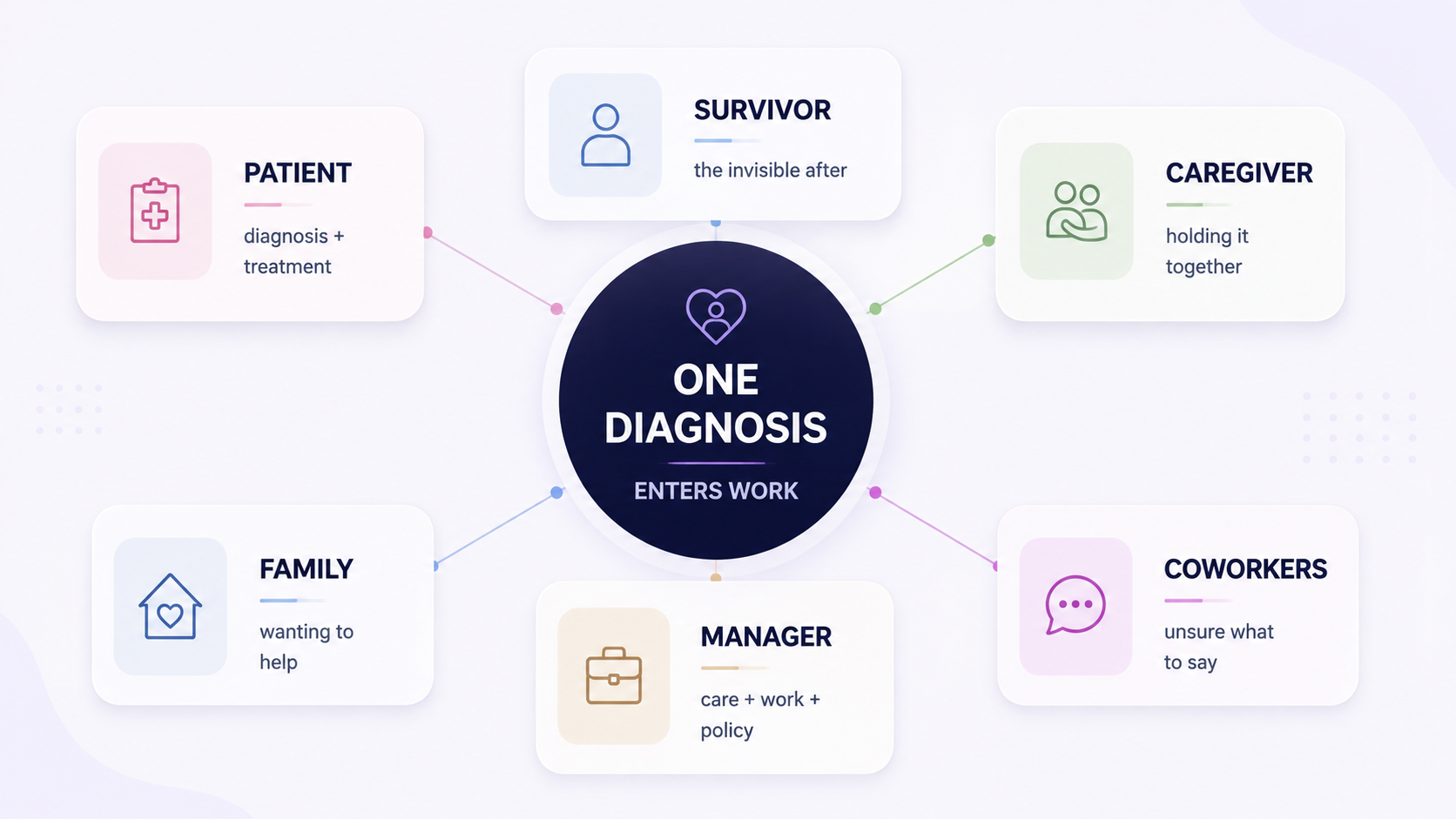
The diagnosed employee
May be balancing appointments, treatment, side effects, uncertainty, work responsibilities, and decisions about disclosure.
The manager and team
Must balance compassion, privacy, workload, and changing needs — often without training or a shared playbook.
The caregiver
May be managing transportation, medications, insurance, household responsibilities, and emotional support while still trying to perform at work.
The survivor and family
May keep carrying the emotional, physical, spiritual, and financial aftermath long after treatment or the initial crisis ends.
A workplace cancer response built only around the diagnosed employee is too small for the reality of cancer.

Support cannot work when people are afraid to be seen using it.
Privacy is not a minor concern in workplace cancer support. It is often the concern.
In the 2024 Cancer and Careers/Harris Poll survey, one in five adults who worked during treatment said they were concerned about whether to disclose their diagnosis at work.[4]
Federal disability rules also generally require employers to keep employee medical information confidential, with limited exceptions. Managers should understand that privacy is not just etiquette. It is part of a responsible workplace response.[5]
Employees may quietly wonder:
- Who will find out?
- Will I still be trusted with important work?
- Will people begin treating me differently?
- Will this affect my career?
- Will my private situation become office conversation?
Disclosure itself can feel risky. People may need support while being deeply reluctant to identify themselves as someone who needs it.
- How they enter the support experience
- Which role they choose
- How much they share
- When they are ready to connect
- Whether faith is part of their experience
What the employer should see
Aggregate participation and learning — not personal stories, diagnoses, prayer requests, or medical details.
"Privacy is not merely a feature of workplace cancer support. Privacy is the doorway to it."
CancerWalk at Work is positioned around a private employer neighborhood, role-based support, and anonymized employer reporting.[8] Exact privacy, access, data, and reporting terms should be documented for each employer pilot.

Nobody intentionally designed your current cancer response.
It grew one program at a time. Each program solved a real problem. The person affected by cancer is still left to assemble the whole response.
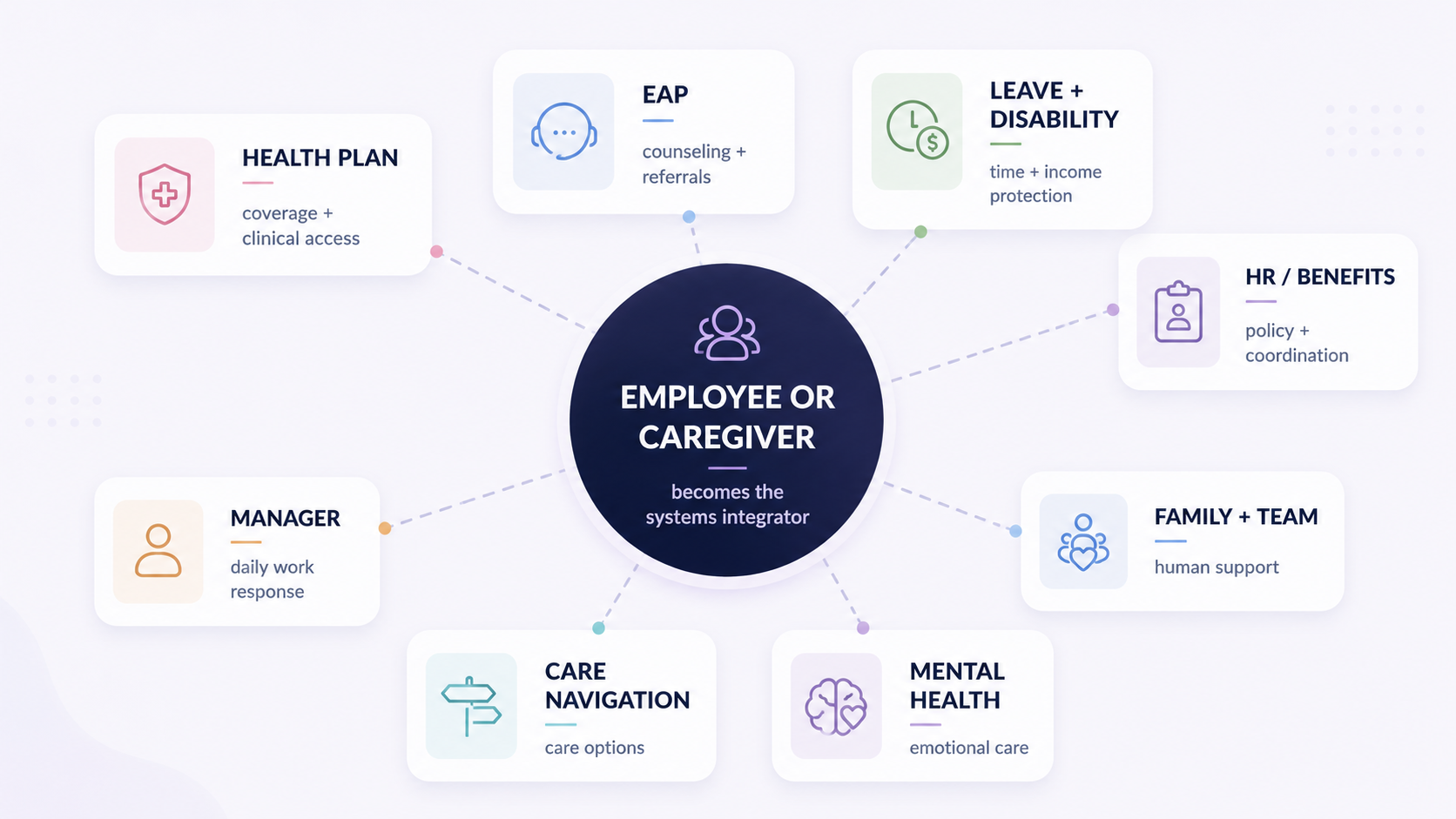
What the current system does
It covers medical care, leave, counseling, policy, and navigation through separate programs and owners.
What may still be missing
One trusted place for the human questions: "What do I say? Who understands? How do I keep working? Where can I be honest?"
The employee should not have to become the systems integrator for your benefits stack while processing a cancer diagnosis.

Good intentions are not a playbook.
Most managers care. They want to respond with empathy. They do not want to say the wrong thing. Most have never been trained to handle a cancer disclosure.
adults in the 2024 Cancer and Careers/Harris Poll said people at work would benefit from formal training on how to support someone with cancer.[4]
Managers need practical guidance on how to:
- Receive a disclosure without panicking or prying
- Respect privacy and clarify what may be shared
- Discuss work needs without making assumptions
- Know when and how to involve HR
- Communicate appropriately with the team
- Support caregivers and returning employees
- Follow up after the first crisis passes
- A counselor
- A doctor
- A legal expert
- A cancer navigator
- The keeper of every answer
A safe first response and a responsible bridge to the organization's support system.
The manager's job is not to treat cancer. It is to respond safely, manage work fairly, and help the person find the right support.

Trust can be built — or broken — in a few minutes.
An employee walks into a manager's office and says: "I need to tell you something. I have cancer." The manager does not need to solve everything. They need a responsible first response.
What an unprepared manager may do
- Immediately share a personal cancer story
- Ask what stage it is or press for medical detail
- Promise that no one else will be told
- Say "take all the time you need" without knowing policy
- Begin redistributing work before asking what the employee wants
Usually, none of this comes from bad intent. It comes from having no script.
Simple, human, and responsible
"Thank you for trusting me with this. I am sorry you are carrying it. What would be most helpful from me today? Let's talk about what may need to be shared, who should be involved, and how we can connect you with the right support."
What the employee may remember
They may not remember every benefit, policy, or phone number handed to them that day.
They will remember whether the first person they told made them feel safe.
The five moves
Slow down
Do not rush to fill the silence.
Listen
Let the employee define what they need today.
Protect dignity
Avoid assumptions, pity, or intrusive questions.
Clarify the next step
Explain who may need to be involved and why.
Follow up
Support should not disappear after the first conversation.
This conversation framework is general education, not legal advice. Employers should adapt manager language and escalation procedures with HR, benefits, privacy, and legal counsel.

Work can become part of the pressure — and part of the person's stability.
The instinctive response is often: "Forget about work. Go home and take care of yourself." Sometimes time away is exactly what the person needs. Sometimes it is not what they want.
said financial need was a top reason to continue working.
said work provides a sense of purpose.
wanted to keep life as normal as possible.
said working through treatment helped them cope.
Cancer and Careers/Harris Poll findings among working people with cancer and survivors.[2]
For many people, work provides routine, identity, purpose, health insurance, financial stability, and a part of life that cancer has not taken over.
At the same time, treatment can affect energy, concentration, scheduling, income, and the ability to perform physical or mental tasks. Cancer-related financial toxicity is tied not only to medical bills, but also to missed work and reduced earning capacity.[7]
The humane question is not:
"Should this person keep working?"
It is:
"What does this person need to keep working, step back, take leave, or return with dignity?"
said workplace support had a positive impact on recovery, and 67% said it positively affected their ability to receive or adhere to treatment.[4] These are self-reported associations, not proof of causation.
The goal is not to push people to keep working. The goal is to help them retain choice, dignity, and connection.
A return date is not a recovery date.
Workplace attention is usually highest after diagnosis. Then treatment ends, the employee returns, and everyone quietly assumes the difficult part is over.
Survivorship can carry its own invisible weight: follow-up appointments, fatigue, changes in concentration, fear before every scan, anxiety about recurrence, grief over what changed, and financial pressure left by treatment.
CancerWalk describes survivors as people carrying the invisible "after" of cancer long after treatment ends.[8]
of survivors still report work limitations affected by cancer-related problems one to five years after diagnosis.[2]
What may remain visible
Appointments, formal leave, modified schedules, physical changes.
What may become invisible
Fatigue, fear, grief, concentration changes, scan anxiety, financial stress.
What support must remember
The human experience may continue long after the obvious medical event.
"Many support systems arrive at diagnosis and disappear at the moment people are expected to be 'normal' again."

Caregivers are employees too.
The employee may never receive a cancer diagnosis. Their spouse, child, parent, or closest friend might. Cancer still enters the workday.
of informal cancer caregivers in an NCI-cited profile were employed while caregiving.
was the average work week among those employed caregivers.
reported high emotional stress related to caregiving.
reported high financial strain.
National Cancer Institute, Informal Caregivers in Cancer.[6]
The caregiver workday may include:
- Scheduling and attending medical appointments
- Transportation, medications, meals, and household care
- Insurance calls and clinical coordination
- Working from hospital waiting rooms
- Sleeping badly and still showing up
- Trying not to let the team down
Caregivers may not identify with a patient support group. They may feel they are not the person allowed to ask for help.
Peer-reviewed U.S. research suggests roughly one in four informal cancer caregivers make employment changes after a diagnosis.[10]
Why CancerWalk includes caregivers and family
The person holding everything together also needs somewhere they can be honest, find practical support, and connect with people who understand the role they are carrying.[8]
The caregiver who keeps showing up for everyone else still needs somewhere they can stop pretending to be fine.

Faith-friendly. Never forceful.
For many people, faith becomes an important source of strength during cancer. They may want prayer, Scripture, hope, or a conversation about God.
Other people may not want any of those things. Some may be uncertain. Some may be angry. Some may have been wounded by religion. Some may simply want human support without spiritual conversation.
CancerWalk's position is clear
- Prayer is welcome.
- Scripture is available.
- Hope can be spoken.
- No one is pressured, cornered, or shamed.
Faith belongs in the room when the person invites it. It should never become the price of belonging.
Whole-person support recognizes five areas cancer can affect:
The spiritual pillar is one part of the person — not a requirement placed on the person. In an employer program, participation in faith-related support should always be voluntary and clearly communicated as optional.[8][9]
"This community is meant to comfort, never to pressure."
Karren Tyler · Founder, CancerWalk[9]
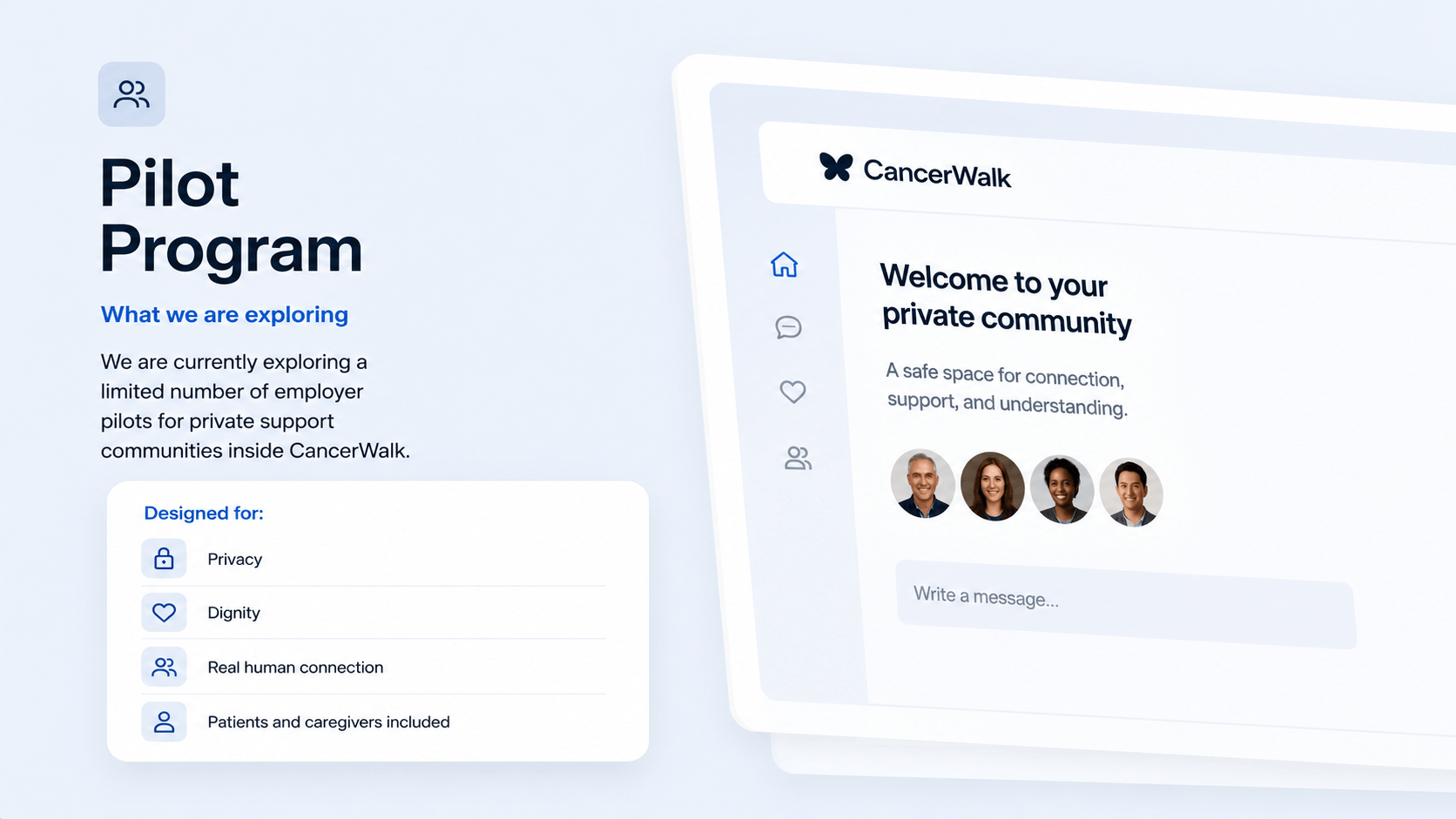
What CancerWalk at Work actually is.
Not another content library. Not a replacement for existing benefits. A human support layer that helps people find connection, guidance, and a safer next step.
Private employer neighborhood
A dedicated space inside CancerWalk for employees and immediate family members affected by cancer.
Role-based entry
Patient, survivor, caregiver, and friend/family pathways.
Private CancerTalks
Live guided conversations where people connect with others who understand.
At Work Academy
Practical training for managers, HR, employees, and coworkers.
Manager tools
Guides, empathy scripts, and conversation language for difficult moments.
Launch support
HR and internal communications tools that explain the program and privacy promise.
Broader community access
A path into the larger CancerWalk community when the participant is ready.
Anonymized reporting
Aggregate participation insight without turning personal stories into management data.
Employers with 500–5,000 employees, self-insured employers, healthcare, financial institutions, higher education, municipalities, manufacturing and logistics, and faith-aligned organizations.[8]

Do not promise medical ROI in 90 days. Prove that the support system works.
A launch email is not a launch. A private space is not useful unless people understand it, trust it, and have a reason to return.
- Map existing benefits and escalation paths.
- Define privacy and reporting boundaries.
- Name executive and HR sponsors.
- Measure manager confidence before training.
- Open the private neighborhood.
- Explain the four role-based paths.
- Clarify optional faith support.
- Train the first manager and HR cohort.
- Host private CancerTalks.
- Publish role-based support.
- Guide people toward meaningful actions.
- Reinforce manager readiness.
- Measure participation and repeat use.
- Review employee-reported safety.
- Reassess manager confidence.
- Recommend continuation or redesign.
What a responsible pilot can prove
- Employees and families can find the support
- People understand the privacy promise
- Participants take meaningful support actions
- Managers complete training and report greater confidence
- The program fits the organization's culture and benefits strategy
What 90 days cannot responsibly prove
- Lower cancer claims caused by the program
- Reduced disability duration without sufficient data
- Improved clinical outcomes caused by community support
- Retention or absence impact without a longer evaluation window
"The honest promise: determine whether employees and families can find, trust, and use the support — and whether managers are better prepared when cancer enters the workplace."
CancerWalk's current employer offer uses a 90-day pilot to evaluate engagement, community participation, CancerTalk attendance, employee feedback, and organizational fit.[8]

Measure meaningful support, not registrations.
A login is not evidence that the program helped. The pilot needs one clear north-star measure leadership can understand.
A meaningful action might include:
- Choosing the pathway that matches the participant's role
- Attending a private CancerTalk
- Requesting or offering support
- Connecting with another participant
- Using a relevant manager or employee resource
- Returning for a second interaction
- Manager training completion
- Pre- and post-training confidence
- Repeat participation
- Employee-reported safety and helpfulness
- Awareness of where to find support
- Anonymized themes for program improvement
Can people find it?
Awareness, enrollment, pathway selection.
Do they trust it?
Meaningful actions, return visits, live participation.
Did it help?
Safety, helpfulness, confidence, qualitative themes.
The organizations that measure meaningful support can improve meaningful support. Everyone else measures clicks and hopes.
Longer-term measures such as retention, absence, disability duration, benefit utilization, and cost require sufficient time, appropriate data permissions, privacy safeguards, and careful attribution.

Three moves, in order of commitment.
Follow the employee journey
Walk through diagnosis, disclosure, manager response, HR involvement, benefits navigation, working during treatment, leave, caregiving, return to work, and survivorship.
Mark every place where the person has no clear next step.
Pressure-test manager readiness
Ask managers what they would say, what they would not say, how they would protect privacy, when they would involve HR, and where they would send the employee or caregiver for support.
Run a focused 90-day test
Establish the privacy promise, launch the neighborhood, train managers, activate live support, measure meaningful use, and learn before expanding.
Stop guessing where your workplace response breaks.
A 30-minute working session for HR, Benefits, Wellbeing, and People leaders. Walk us through your current cancer journey. Together, we map privacy risks, manager gaps, caregiver blind spots, fragmented benefits, and what a responsible pilot could test.
You leave with a written Workplace Cancer Support Gap Map that your organization can keep, whether or not you move forward with CancerWalk.
Start the Conversation30 Minutes · Not a Product Demo · You Keep the Map

People remember how their employer responded when life became difficult.
A note on the research.
Industry and research figures in this briefing are included to frame the workplace support problem. Survey findings are not universal, and self-reported associations should not be interpreted as proof that workplace support alone caused medical or employment outcomes. Employers should use their own population, benefit, absence, and engagement data when evaluating a program.
- [1] American Cancer Society
- Cancer Facts & Figures 2026. Approximately 2.1 million new U.S. cases expected in 2026; about 18.6 million Americans living with a history of invasive cancer as of January 1, 2025. cancer.org · Cancer Facts & Figures 2026
- [2] Cancer and Careers
- The Issue. Working-age incidence, survivor work limitations, and 2023 Harris Poll findings on financial need, purpose, normalcy, and coping through work. cancerandcareers.org · The Issue
- [3] Business Group on Health
- 2026 Employer Health Care Strategy Survey and Taking Action on Cancer. Cancer as the leading employer health care cost driver; 88% among top three and 58% primary driver among surveyed employers. businessgrouphealth.org · 2026 survey
- [4] Cancer and Careers / The Harris Poll
- Navigating Cancer and Work: Employee Experiences (2024 survey, published 2025). Disclosure concern, workplace training, recovery, and treatment adherence findings. cancerandcareers.org · 2024 survey
- [5] U.S. Equal Employment Opportunity Commission
- Cancer in the Workplace and the ADA and guidance on disability-related inquiries, accommodations, and confidentiality of medical information. eeoc.gov · Cancer and the ADA
- [6] National Cancer Institute
- Informal Caregivers in Cancer (PDQ). Profile data on employed caregivers, work hours, emotional stress, and financial strain. cancer.gov · Informal Caregivers in Cancer
- [7] National Cancer Institute
- Financial Toxicity and Cancer Treatment (PDQ). Work, income, and financial effects of cancer and treatment. cancer.gov · Financial Toxicity
- [8] CancerWalk
- CancerWalk at Work. Current offer, employer and employee experience, Academy topics, pilot structure, target organizations, role-based entry points, optional faith-friendly support, and anonymized engagement reporting. cancerwalk.com/at-work
- [9] CancerWalk
- You Don't Have to Walk Alone. Community model, anonymous participation in the broader community, faith positioning, and founder statement. cancerwalk.com
- [10] de Moor JS, et al.
- Employment Implications of Informal Cancer Caregiving. Journal of Cancer Survivorship (2017); research indicating approximately one quarter of caregivers make employment changes. NIH / PubMed Central
Important scope note
CancerWalk at Work is a community, education, and workplace support offering. It is not medical care, diagnosis, treatment, crisis intervention, legal advice, an EAP, or a replacement for an employer's existing health, leave, disability, or accommodation processes.

People remember how their employer responded when life became difficult.
See how CancerWalk could support your people.
In a free, 20-minute Employer Cancer Support Review, we’ll discuss your current approach, show you how CancerWalk at Work operates, and explore where it could complement your existing employee support.
Request My Employer ReviewFor HR, benefits, and executive leaders. No obligation to launch a pilot.